
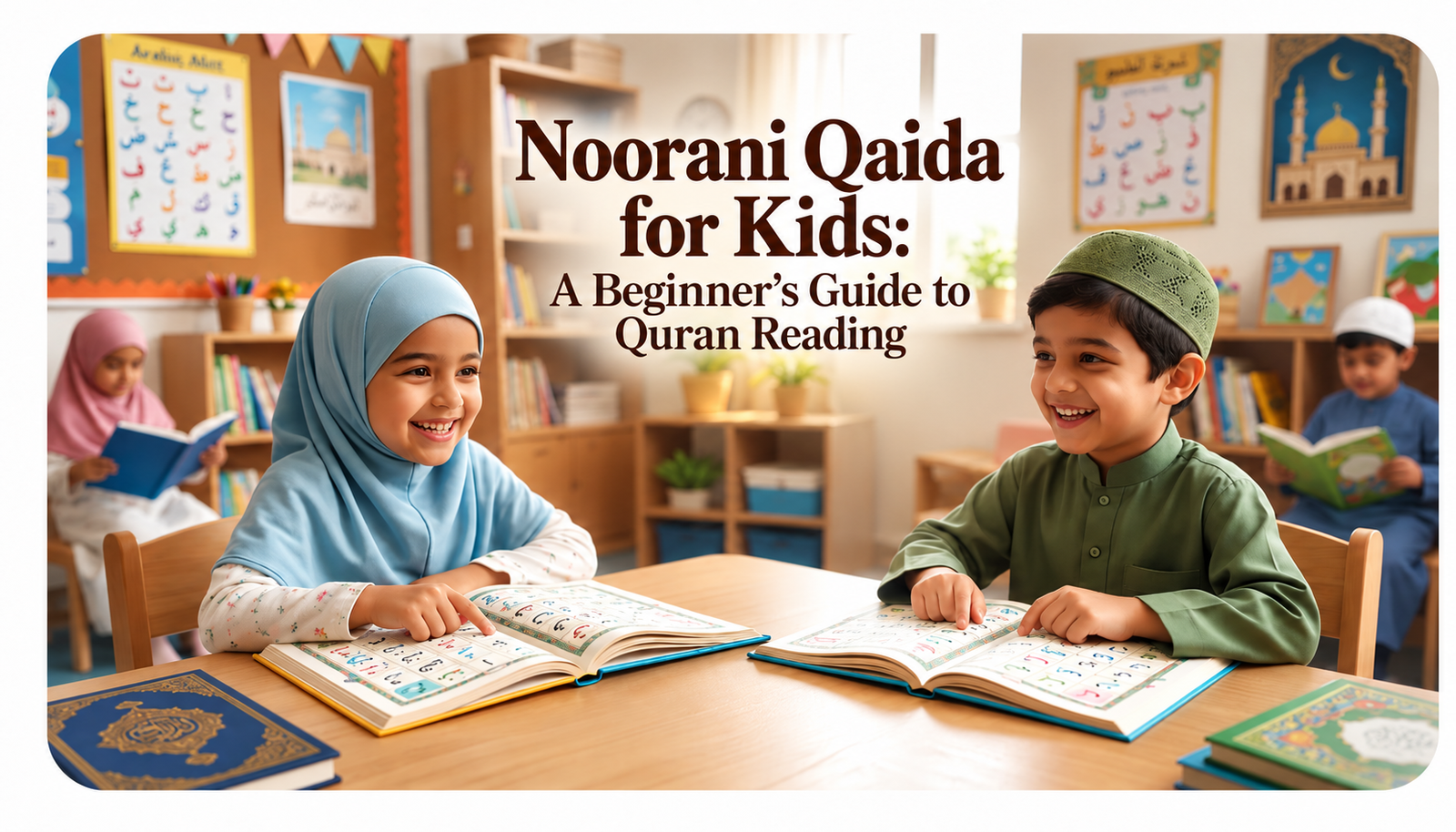
Every parent who wants their child to read the Quran faces the same first question: where do we start? For most families, the answer is Noorani Qaida. It is a simple, structured primer that takes children from recognising Arabic letters to reading short, fully vowelled words.
This guide explains what Noorani Qaida for kids involves, when children are usually ready to begin, what they learn at each stage, and how you can support them at home. Whether your child learns with you, at a local masjid or in online classes with an academy such as Latifia Quraner Alo, the same foundations apply.
What Is Noorani Qaida?
Noorani Qaida is a beginner’s book for learning to read Arabic as it is written in the Quran. It is commonly attributed to Maulana Noor Muhammad Ludhianvi and is used widely across South Asia, the UK, North America and beyond.
Its purpose is narrow and practical: to teach a child how to decode Quranic Arabic correctly, not to teach the meaning of the words.
The Qaida works in small, ordered steps:
- It introduces the Arabic letters one by one, with their correct sounds.
- It shows how letters change shape when they join together.
- It adds vowel marks, so children learn how each letter is voiced.
- It builds up to short words and phrases taken from or modelled on the Quran.
By the time a child finishes, they should be able to sound out unfamiliar Quranic words on their own. That is the skill they need before moving on to reading the Quran itself.
Why Is Noorani Qaida Important for Kids?
The Quran is written in a script most children outside the Arab world have never seen. Noorani Qaida breaks that script into manageable pieces, so children are not overwhelmed.
It helps children with five core skills:
- Letter recognition: identifying each of the 28 Arabic letters in their different forms.
- Pronunciation: producing sounds that do not exist in English, such as ع (‘ayn), ح (ḥā) and ق (qāf), from the correct point in the mouth (Makharij).
- Vowel marks: understanding how small symbols above and below letters change the sound.
- Reading confidence: succeeding at short, achievable lessons, which keeps young learners motivated.
- A foundation for Quran reading: a child who reads the Qaida accurately usually finds the move to the Quran far smoother.
Starting with correct sounds also matters later. Pronunciation habits formed early are hard to undo, so careful teaching at this stage saves time and frustration.
What Age Should Children Start Learning Noorani Qaida?
There is no single right age. Readiness depends on the individual child rather than a number on a birthday card.
Some children are ready at four or five; others do better a little later. Look for these signs:
- They can sit and focus for 10–15 minutes.
- They can recognise shapes and copy sounds accurately.
- They show curiosity about letters or the Quran.
- They can follow simple instructions from an adult.
If your child struggles to concentrate or becomes upset, it is fine to pause and try again in a few months. A gentle start is better than a stressful one. Children with additional learning needs may simply need shorter sessions, more repetition and a patient teacher.
What Do Children Learn in Noorani Qaida?
The Qaida is divided into lessons that each introduce one new idea. Editions vary slightly, but most cover the following areas in this order.
Recognising Arabic Letters
Children start with the individual letters, from alif (ا) to yā’ (ي). They then learn that most letters take different shapes at the beginning, middle and end of a word. Seeing the same letter in several forms is often the first real challenge, so this stage deserves time.
Learning Fathah, Kasrah and Dammah
These are the three short vowel marks, known together as Harakat:
- Fathah: a small diagonal line above a letter, giving an “a” sound (بَ = ba).
- Kasrah: the same line below a letter, giving an “i” sound (بِ = bi).
- Dammah: a small curl above a letter, giving a “u” sound (بُ = bu).
Once children understand Harakat, they can start reading letters as syllables rather than names.
Understanding Tanween
Tanween is a doubled vowel mark that adds an “n” sound to the end of a word. A double Fathah gives “an”, a double Kasrah gives “in” and a double Dammah gives “un” (بً = ban, بٍ = bin, بٌ = bun). Children usually meet it at the ends of words.
Learning Sukoon and Shaddah
- Sukoon is a small circle above a letter. It means the letter has no vowel, so the sound stops (as in أَبْ = ab).
- Shaddah is a small “w”-shaped mark. It means the letter is doubled, pronounced twice with emphasis (as in رَبَّ = rabba).
These two marks are where many beginners make mistakes, so expect extra practice here.
Practising Madd and Letter Combinations
Madd means lengthening a sound. Children learn that alif, wāw and yā’ can stretch a vowel for longer (بَا = baa, بُو = boo, بِي = bee). They also practise reading several joined letters together, which is the bridge to reading whole words.
Developing Basic Pronunciation Skills
Throughout the Qaida, the teacher corrects how each letter is produced. Similar-sounding letters such as س (sīn) and ص (ṣād), or ت (tā’) and ط (ṭā’), need careful listening. Transliteration can help as a rough guide, but it cannot replace hearing a qualified reciter. Our earlier guide on learning Noorani Qaida in English explains how to use English pronunciation aids sensibly.
How to Teach Noorani Qaida to Children Step by Step
If you are teaching at home, or supporting a teacher’s lessons, this sequence keeps progress steady.
Step 1 — Introduce Arabic Letters Gradually
Teach two or three new letters per session, not a whole page. Point to each letter, say its name clearly and ask your child to repeat it. Move on only when they can recognise the letters without help.
Step 2 — Practise Letter Sounds
Focus on how each letter sounds, not just its name. Exaggerate difficult sounds slightly so your child can hear the difference. Short audio clips from a reliable reciter can help train their ear.
Step 3 — Introduce Harakat
Add Fathah, Kasrah and Dammah one at a time. Practise the same letter with all three vowels (ba, bi, bu) before moving to new letters. This repetition builds the pattern quickly.
Step 4 — Practise Connected Letters
Show how letters join to form syllables and short words. Read slowly together, with your finger under each letter. Let your child lead once they feel confident.
Step 5 — Review Previous Lessons
Start each session by revising the last lesson for a few minutes. Regular revision stops earlier lessons from fading and shows your child how much they have learnt.
Step 6 — Progress Towards Basic Quran Reading
Once your child reads the final Qaida lessons accurately, they can begin reading from the Quran, usually starting with the short surahs of the 30th Juz. Many families continue with a structured Nazara (reading from the Mushaf) course, such as our Online Nazara Program, to build fluency.
Tips to Make Noorani Qaida Learning Easier for Kids
- Keep sessions short and consistent: ten to twenty minutes every day usually works better than one long weekly session.
- Repeat and revise: children need to see a letter or rule many times before it sticks.
- Encourage generously: praise effort, not just accuracy. A sticker chart or small reward can help younger children.
- Use age-appropriate materials: a clear, large-print Qaida is easier for small children than a dense edition. For basic Tajweed reference at home, you can download our free Prathomik Tajweed guide.
- Correct gently: model the right sound and ask your child to try again, rather than saying “wrong”.
- Avoid pressure: comparing your child with siblings or classmates often reduces motivation.
- Get a qualified teacher when needed: if you are unsure of your own pronunciation, a trained Quran teacher can prevent errors becoming habits.
Parent tip: if you did not learn Tajweed yourself, sit in on your child’s lessons. You will pick up the correct sounds alongside them and can guide home practice with more confidence.
Can Kids Learn Noorani Qaida Online?
Yes. Many children now learn Noorani Qaida through live online lessons, especially where there is no suitable local class. Live video lessons allow a teacher to listen to the child read and correct pronunciation in real time.
Online learning tends to work best when:
- The teacher is suitable: qualified in Quran reading and experienced with children.
- The approach suits the child’s age: short activities, clear explanations and patience.
- Attendance is regular: missed lessons slow progress more than most parents expect.
- Parents stay involved: sitting nearby for young children and checking homework.
- Practice continues between lessons: a few minutes daily reinforces what the teacher covered.
Recorded videos can supplement lessons, but they cannot hear your child read. For pronunciation, live feedback matters.
How Long Does It Take for Kids to Learn Noorani Qaida?
There is no fixed timeline. Some children complete the Qaida in a few months; others take a year or more, and both are normal.
Progress depends on:
- Starting level: whether the child already knows any letters.
- Practice frequency: daily practice moves faster than weekly practice.
- Attendance: consistent lessons maintain momentum.
- Age and individual needs: younger children often need smaller steps.
- Revision and teacher guidance: accurate correction prevents having to relearn.
Focus on accuracy rather than speed. Rushing through the Qaida often leads to mistakes that slow Quran reading later.
How Parents Can Support Their Child’s Quran Learning
- Set a fixed time: for example, straight after school or before bedtime, so practice becomes routine.
- Create a calm space: a quiet corner with the Qaida, away from screens and noise.
- Sit with younger children: your presence helps them focus and shows the lesson matters.
- Listen to them read daily: even five minutes of listening reinforces the teacher’s work.
- Stay in touch with the teacher: ask what to practise and where your child is struggling.
- Celebrate milestones: finishing a lesson or reading a first word deserves recognition.
- Model the habit: children who see parents reading the Quran are more likely to value it.
Help Your Child Begin Their Quran Reading Journey
Noorani Qaida gives children a clear path from their first Arabic letter to their first words of the Quran. Our live online programme covers the full Qaida, Makharij and direct Quran reading practice for students aged eight and above.
Explore Our Noorani Qaida ProgrammeHave a child aged 4–7? Explore our Little Hifz Program or contact us to discuss the most suitable option.
Frequently Asked Questions About Noorani Qaida for Kids
What is Noorani Qaida for kids?
It is a beginner’s primer that teaches children Arabic letters, vowel marks and basic reading rules so they can learn to read the Quran correctly.
At what age can a child start Noorani Qaida?
There is no fixed age. Many children start when they can focus for 10–15 minutes and copy sounds accurately, which for some is around four or five.
Can children learn Noorani Qaida online?
Yes. Live online lessons with a qualified teacher allow real-time pronunciation correction. Regular attendance and home practice make the biggest difference.
How long does it take to learn Noorani Qaida?
It varies. Depending on age, practice and attendance, children may take a few months or more than a year. Accuracy matters more than speed.
Is Noorani Qaida suitable for beginners?
Yes. It starts from the first letter of the alphabet and assumes no prior knowledge of Arabic, so it suits complete beginners of any age.
What is the difference between Noorani Qaida and Quran reading?
Noorani Qaida teaches the building blocks: letters, sounds and vowel marks. Quran reading (Nazara) applies those skills to reading directly from the Mushaf.
Does Noorani Qaida teach Tajweed?
It introduces basic Tajweed foundations, such as correct letter sounds, Madd and Shaddah. Full Tajweed rules are usually studied afterwards in a dedicated course, such as reading the Quran with Tajweed, and later Tajweed and advanced recitation.
How can parents help children practise Noorani Qaida at home?
Set a short daily routine, revise previous lessons, listen to your child read, correct gently and follow the teacher’s guidance on what to practise.